
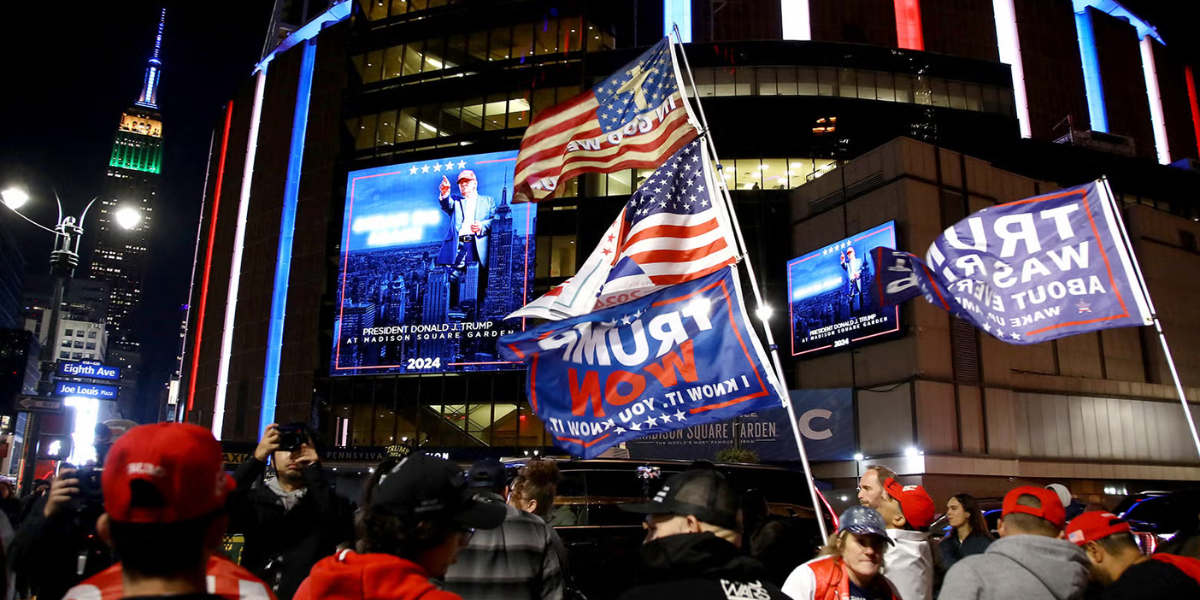
Donald Trump’s recent rally at Madison Square Garden in New York City has sparked significant controversy, highlighting the increasing polarization in American politics. Originally intended to solidify Trump’s political base, the event instead drew fierce criticism, igniting debates on the limits of free speech, the responsibilities of public figures, and the ethical obligations of those with vast influence. What began as a strategic effort to demonstrate his enduring political relevance became a flashpoint, forcing the country to confront the state of its political discourse.
A Bold Challenge in Liberal Territory
The Madison Square Garden rally took place in a city traditionally aligned with Democratic values, making it a clear attempt by Trump to assert his continued influence, even in liberal strongholds. The event attracted high-profile attendees, including tech magnate Elon Musk and former New York Mayor Rudy Giuliani, signaling that Trump remained a dominant force within the Republican Party. The rally’s location itself was part of a broader strategy to show that Trump’s political influence transcended regional and ideological boundaries. However, despite the star-studded crowd and the apparent political messaging, the rally quickly descended into controversy.
The Hinchcliffe Incident: Crossing the Line
One of the most contentious moments of the rally came during comedian Tony Hinchcliffe’s performance. Known for his edgy, often controversial comedic style, Hinchcliffe’s routine quickly became problematic as it targeted marginalized groups, including Latinos, Black Americans, Jews, and Palestinians. His performance, which many expected to push boundaries of humor, crossed a line for many viewers, who labeled the jokes as not just offensive but borderline hate speech.
The uproar that followed Hinchcliffe’s set became a focal point of national conversation. Social media erupted with criticism, with voices from both sides of the political spectrum condemning the routine. The backlash raised an essential question: can humor, especially in a politically charged environment like a Trump rally, still serve as a tool for social critique without reinforcing harmful stereotypes or deepening societal divides? Civil rights organizations, political analysts, and even other comedians distanced themselves from the performance, urging a more thoughtful approach to comedy, particularly when the stakes for national unity are so high.
The DNC’s Response: A Call to Confront Authoritarian Rhetoric
In direct response to the rally, the Democratic National Committee (DNC) launched a campaign designed to challenge Trump’s rhetoric. Projecting sharp criticisms onto the iconic facade of Madison Square Garden, the DNC made a stark comparison between Trump’s language and that of authoritarian leaders throughout history. The visuals were part of a broader campaign aimed at framing the rally as a dangerous moment in American political history—one that underscored the risks of unchecked populism.
DNC Chair Jaime Harrison condemned Trump’s language, emphasizing the significant impact that words from political leaders can have on public discourse. Harrison called for increased vigilance against rhetoric that undermines democratic values, warning that divisive statements could further fracture the country’s already fragile unity. The DNC’s counter-campaign was not just a political response but a moral stance, designed to highlight the growing ideological rift that is shaping the 2024 election cycle.
Free Speech vs. Responsibility
The aftermath of the rally has brought broader questions about the balance between free speech and the ethical responsibilities of public figures into the spotlight. Defenders of Hinchcliffe’s routine argue that comedy should remain a space free from censorship, serving as a critical outlet for pushing societal boundaries. However, critics argue that public figures, especially those with immense platforms, should be mindful of the potential harm their words can cause, particularly when they wield such influence in a politically charged climate.
This debate reflects a deeper tension in American society: how can the country preserve the right to free expression while ensuring that harmful rhetoric does not erode the foundations of a cohesive, civil society? As the nation grapples with these complex issues, the debate over the role of humor, satire, and public discourse will only grow in importance, influencing both political rhetoric and societal norms moving forward.
A Divided Nation as the Election Approaches
As the 2024 election draws nearer, Trump’s Madison Square Garden rally will likely remain a polarizing issue. For many of his supporters, the event symbolized a rejection of political correctness and a celebration of free speech unfiltered by societal expectations. For his detractors, it represented a dangerous legitimization of divisive, even hateful, rhetoric that threatens to further fragment an already divided nation.
The country is now deeply split on the issues of free speech, the ethical obligations of public figures, and the potential consequences of their words. The fallout from this rally has illuminated the significant ideological rift that defines the 2024 election season. As the election approaches, the controversy surrounding Trump’s rally will continue to influence the direction of public discourse and shape the broader political conversation in the coming months.
